
Relationships Between Zero and Infinity and their Applications in Probability
This was my first attempt at writing my IB HL Mathematics internal assessment (final project in grade 12). It didn't end up meeting the specific requirements, but I think it's an interesting essay. Originally written in September 2016 (I drafted this while I was couchsurfing in Paris in the summer).
Introduction
When we think of numbers, we often imagine a number line a little like this:

This is the basic real number line, where each point corresponds to a real number, which are linearly ordered with larger numbers to the right and smaller numbers to the left, with no maximum or minimum element. It can be compactified (meaning there is an end and a beginning) into the extended real line which ends in negative and positive infinity.

It can also be compactified into the real projective line, in which there is only one endpoint at infinity.

Zero and infinity seem to be essential to our understanding of numbers and mathematics, and yet they often don’t follow the rules and tend to cause a lot of problems. In this essay, I hope to get some more insight on the properties of zero and infinity, why they behave the way they do and how they can be useful to us.
Zero is the number symbolising no amount and is also used as a placeholder digit. It is the only number that is not positive or negative. It is an even number, as it is divisible by 2 (0/2=0) and is surrounded by odd numbers (1 and -1). You could even say zero is the “most even” number of all, as it is not only divisible by 2 but by every power of 2, which is relevant to the binary numeral system used by computers. Zero is not a prime number as it has an infinite number of factors and it is also not a composite number as it cannot be expressed by multiplying prime numbers. Even though zero has some unique traits, it is still a fairly straight-forward number that can be used easily in many fields of mathematics.
Infinity, however, is a lot more abstract. Rather than being an actual number, it is a concept describing something without any bound or larger than any number. The concept has use in some areas of mathematics such as calculus and set theory but generally it can’t be used as an ordinary number in mathematics. Even the simplest equations don’t work normally with infinity: ∞ + 2 is still ∞, as you can’t make an amount 2 numbers larger than ∞ – infinity already encompasses every amount in the universe.
Infinity and zero can be seen as being opposites – zero is nothing, infinity is everything. However, as they function very differently they can’t be treated as opposites in mathematics. Generally opposite numbers are those which are on different sides of the number line but have the same distance from 0; for example, 4 and -4. There are certain rules for dealing with opposite numbers – if you add them, you get 0 (-4+4=0), if you divide them you get -1 (-4/4=-1). These clearly don’t apply to zero and infinity.
I have decided to investigate this topic purely out of personal interest – I enjoy number theory. I think it helps to understand mathematics and how and why different things occur if you understand how exactly numbers themselves work. We tend to only think about the mathematical processes and not the individual parts that make up the process. Zero and infinity are unique mathematical entities that in many ways form the basis of mathematical understanding as they are the two extremes of the number line. They are also important in understanding our universe in general – the universe is infinite, but what does that mean? We have to understand the meaning of infinity and all its implications in order to truly understand it.
Relationships between zero and infinity
As I mentioned, both zero and infinity are kind of unique in their properties and can cause some problems in mathematics. One famous problem with zero is division. Why can’t we divide by zero?
Division is the opposite of multiplication: ½=0.5, meaning that 0.5×2=1. If you divide by zero this doesn’t work, as anything multiplied by 0 is also 0: if 1/0=a then a×0 should equal 1, but it doesn’t.
Another way of looking at division is through subtraction: 20/4 is just 4 subtracted from 20 5 times. If you do this with 0 you seem to get infinity, but saying x/0=∞ also causes problems – generally if you saw the equations x/y=z and a/y=z that would signify that x=a, which is not true.
We can investigate division graphically as well. Let’s take the function 1/x where the limit of x approaches 0. If we go from the positive side the graph goes up to positive infinity, but from the negative side it goes down to negative infinity.
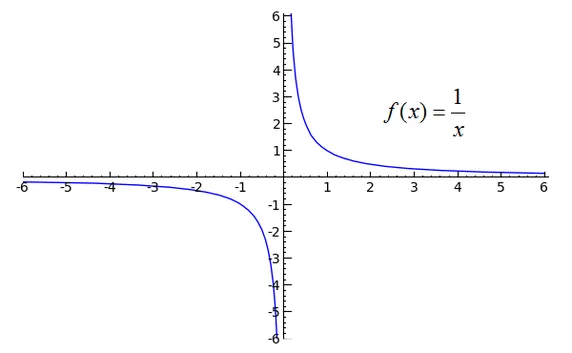
So do these cancel out and equal 0? Or do they encompass everything all together and the answer is truly infinity?
The correct notation for this sort of function would be and , meaning the answer is different depending on whether you come in from the positive or the negative side.
As there seems to be an infinite amount of possible solutions the equation is undefined.
is another interesting equation to look at. If we have the function then is the origin point (0,0). Let’s say we have the line y=y.
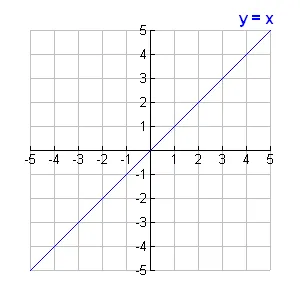
On this line, is always equal to 1: =1; =1; =1; so should be 1 as well.
However, on the line x=-y which also goes through the origin point, is always equal to -1.
On the line x=0, is always equal to zero.
There are an endless number of lines that go through (0,0) and an endless number of solutions to according to those lines. This means is also undefined – it can be anything you want it to be.
One of the first encounters people have with infinity is by counting. There are an infinite amount of numbers – but are these infinite amounts different for different kinds of numbers?
The natural numbers are all positive integers – there is an infinite amount of them. The amount of natural numbers – known as the cardinality of the set – is an infinity called (aleph-naught). The term was coined by Georg Cantor who realised infinite sets can have different cardinalities.
It might make sense to think that the set of all even numbers has a cardinality smaller than the set of all natural numbers, but in fact the two sets have one-to-one correspondence – this means for each member of the natural numbers set there is a member of the even numbers set:
|
Natural numbers |
Even numbers |
|---|---|
|
1 |
2 |
|
2 |
4 |
|
3 |
6 |
|
4 |
8 |
|
5 |
10 |
|
... |
... |
For every natural number n, there will always exist an even number 2n. This means the two sets have the same cardinality – they are both equally infinite.
The aleph-naught cardinality also applies to the set of all integers.


That doesn’t seem to make sense as the integers go off into infinity in both directions while the natural numbers clearly have an end point on one side.
However, you can also order the integers like this: {0, 1, -1, 2, -2, 3, -3…} and now we can clearly see the same one-to-one correspondence with natural numbers, making them equally infinite.
When you can order all the members of a set like this they are what is called a countable set. We can conclude that all countable sets have an infinite cardinality of aleph-naught.
Rational numbers are more interesting because it is a densely ordered set, meaning that between any two rational numbers you can make another rational number (between 1 and 2 is , between 1 and is and so on) – meaning just the rational numbers between 1 and 2 are infinite. Even so, rational numbers are countable. This can be demonstrated with a diagram like this (you count the black ones):

It goes on infinitely on both ends, similarly to integers, and the same way with negative rational numbers. An easier way to understand the one-to-one correspondence might be like this:
|
1 |
1 |
|
2 |
12 |
|
3 |
13 |
|
4 |
14 |
|
5 |
15 |
|
... |
... |
Clearly it goes on forever and both the possible numerators and the possible denominators are infinite… but so are natural numbers.
There do exist sets with cardinalities larger than the infinite aleph-naught. Irrational numbers are uncountable – they have an infinite amount of decimal points that do not repeat, so they are impossible to write down in a way that would allow you to arrange them in any sort of order. You can’t order neverending numbers.
This makes the cardinality of irrational (and all real) numbers larger than aleph-naught. However, we cannot know if there is a set with a cardinality larger than aleph naught and smaller than the cardinality of all irrational and real numbers, and this is something that can never be proven or disproven.
Aleph-naught () is the smallest infinity, is the second-smallest, the third smallest and so on. There are probably an infinite amount of infinites. They can be calculated with much like numbers, but the results are very different. as is infinitely larger than and it does not make a difference – it’s like adding a real number to any infinity, the answer will still just be infinite. The same with multiplication: .
Implications in sets of zero and infinity
Many people think that because the universe (or multiverse) is infinite, everything possible must happen. There is an infinite amount of universes so any event that could possibly occur must occur in at least one of them. It is also often thought that every possible event must also occur an infinite amount of times in the infinite amount of universes, leading to the popular idea of infinite parallel universes where everything is the same or only one thing is different.
This would only be true if there were a finite number of possible events, but there are not. With a finite amount of events they would have to repeat infinitely in order to fill up infinite time and space, but with an infinite amount of possible events they don’t even have to repeat at all. There is an extremely low probability of the exact same event occurring more than once among an infinite amount of events – even if there is an infinite amount of time and space for it to occur in. It is possible, but it will only repeat a finite amount of times.
This can be easily seen if we consider the number line again. There are an infinite amount of possible numbers and an infinite amount of space for them… but not a single number ever repeats. A similar principle can be applied to any sort of infinite event. The larger the number of possible events, the smaller the probability of any one of them happening, so with infinite events the probability converges to 0 – leading to a small finite amount of times any one event will happen (generally only 1).
P(event) = is the approximate probability of any one event happening with one trial.
is the approximate probability of any one event happening with an infinite amount of trials.
When talking about probability 0, we have to establish what exactly probability is – it does not mean whether or not an event is possible, meaning a 0 probability event can still happen, it is just very improbable. That is why the above calculations work.
How do you multiply 0 and ∞? There are a few different ways to approach this problem depending on your definition of infinity – which, as I have already said, is not an actual number and can not be treated as one.
For the purpose of this calculation, 0 and ∞ symbolise a quantity converging towards 0 and infinity, making more like where and . Basically multiplying an infinitely small number (0.0000...1) with an infinitely large number will give you 1.
An interesting theorem looking at infinity and probability is the infinite monkey theorem, which states that a monkey hitting keys at random on a keyboard for an infinite amount of time will almost surely type any given text (for example the complete works of William Shakespeare, or the sentence “get me out of here”). In fact, as the amount of texts in the world is finite, it would almost surely type any and every existing text an infinite amount of times.
“Almost surely” in this context is a precise mathematical term meaning a probability of 1. The same way as 0 probability does not mean an event is impossible, a 1 probability event does not always have to happen. The distinction between almost surely and surely becomes important when dealing with infinite sample spaces – in a finite space, probability 1 means the event will always happen, as we know the other events in the sample cannot have a probability more than 0. In an infinite space other events are theoretically possible but with a probability smaller than any fixed positive probability, making their probability 0 – but we can still not say any of these infinite 0 probability events can never occur.
An example of this would be throwing a dart – if you take any random point on a dartboard, the area of the point will be 0, meaning there is technically a 0 probability of the dart hitting the point. You can say the same about every single point on the dartboard, but clearly the dart has to hit one of them. Therefore it is not only possible but in this case necessary for one of the 0 probability events to actually occur.
Here is a proof for the infinite monkey theorem: the probability of two independent events happening equals the product of the probabilities of each event happening independently. Keyboards have about 100 keys, meaning each key has a probability of of being pressed. If we take a 6 letter word like banana, for example, the chance of the first six letters being pressed spelling out ‘banana’ would be , therefore the chance of not typing the word ‘banana’ in the first block of 6 keys pressed is .
The chance of not typing ‘banana’ in any of n blocks of 6 keys pressed is . As n blocks of 6 keys pressed grows, gets smaller. For , , which is already significantly smaller, making the event of ‘banana’ being typed more probable. As the amount of keys goes off into infinite, will eventually approach 0 and the probability of ‘banana’ being typed will reach 1.
If you consider any texts more than a few characters long the amount of characters needing to be typed gets ridiculously large – this essay so far has been around 14000 characters long. The probability of replicating this text with the first 14000 keys pressed would be and in order to reach a probability of 0.01 of replicating this text the amount of keys pressed would need to be .
No matter how unlikely it seems, the probability of any theoretically possible event out of a finite set of events happening in an infinite series of events is always 1. However, this does not mean the absence of an event is impossible – it is only almost impossible.
Probabilities with infinities are of interest in the field of astronomy and physics and everything in between – they help us understand our infinitely expanding universe (or multiverse) and all the possibilities within it.
Conclusion
In this essay I have discussed some of the problems that come up while trying to calculate with zero and infinity and looked at some possible links between them. Many simple calculations are simply unknown or ‘undefined’ with these special elements. I have found that infinites can be different sizes but not the way one may expect, and defined two different cardinal infinities including the smallest one . I have looked at probability with infinite sets and 0 probabilities and found that a probability of 0 does not mean impossibility in a set of infinite possible events.
In a universe born from 0 and now largely defined by infinity, the two are still little understood and cause complications and frustrations in many fields of mathematics. Often explanations for these elements will get philosophical, sometimes even equating infinity with God. Maybe understanding them better will give us the key to understanding where we come from and where we are going.